
Clarke County Federal Release Network
The Federal Bureau of Prisons entry in Clarke County’s facility map is a functional route. It does not represent a local building. A person charged in a federal matter may never enter Northwestern Regional Adult Detention Center, or may stay in a local or contract facility under another authority before designation. A sentenced person may then be placed at a BOP institution anywhere in the country.
Custody can also continue after the BOP display changes. Another jurisdiction may assume custody, ICE may act, or a person may begin court-ordered supervised release. “No longer in BOP custody” answers only the BOP question. It does not prove a return to the Clarke County community or final freedom from every legal restraint.
| Stage | Best route | What it can establish |
|---|---|---|
| Federal pretrial | Federal court record, counsel, clerk, USMS or host facility | Orders, conditions, and the likely physical custodian |
| Designated federal sentence | BOP Inmate Locator | BOP location or published release status |
| Former BOP prisoner | BOP locator plus court record | Past BOP release date and later court obligations |
| Other custody after BOP | The new state, local, or immigration custodian | Whether confinement continued elsewhere |
Search Clarke County Federal Records
The official BOP Inmate Locator covers federal inmates from 1982 to the present. Search by a federal identification number when one is known. The locator also accepts a name with age, race, and sex filters. A register number gives a stronger match than a common name, but every displayed identifier should still be checked.
- Choose the number search when a BOP Register, DCDC, FBI, or INS number is available, and enter the number in the correct field.
- Otherwise use the name search. Add the published filters only when they help distinguish the intended person.
- Open the matching result and record the full name, register number, status or location, release date, and search time.
- Read “RELEASED,” “IN TRANSIT,” “UNKNOWN,” and a facility name exactly as displayed. The terms are not interchangeable.
- Check the federal court record when the legal release order, supervised-release terms, or case chronology is needed.
- If the person may be pretrial or held for another agency, identify the USMS or host-facility path instead of relying on BOP alone.
The BOP locator is one part of the full Clarke County custody and release search. That sequence keeps a federal result separate from NRADC and Virginia Department of Corrections records.
Note: A miss, stale date, or similar name is not a completed release event and calls for a second official source.
Clarke County Federal Release Fields
BOP publishes a compact set of result fields. Each has a narrow purpose. The record does not provide the full federal case file, the reason for every movement, or proof that no other agency took custody. BOP also warns that sentences are recalculated under applicable law and displayed dates may not be current.
| BOP field | How to read it |
|---|---|
| Name | The identity displayed for the federal record; compare all lawful details |
| Register Number | The key BOP identifier for the individual record |
| Age, Race, Sex | Published descriptors that may help separate similar names |
| Release Date | A past date for a completed BOP release or a future projected date, depending on status |
| Location | A BOP facility, “IN TRANSIT,” “RELEASED,” or other displayed wording |
“RELEASED” in the Location field, or a past release date with no facility, means the person is no longer in BOP custody. “IN TRANSIT” means movement within the federal process, not release. A future date is prospective. “UNKNOWN” means the release term is not determined in the display. Preserve the exact text instead of translating it into a broader claim.
Federal Release Results for Clarke
The official federal locator supplies both the search form and the status language used for BOP records.
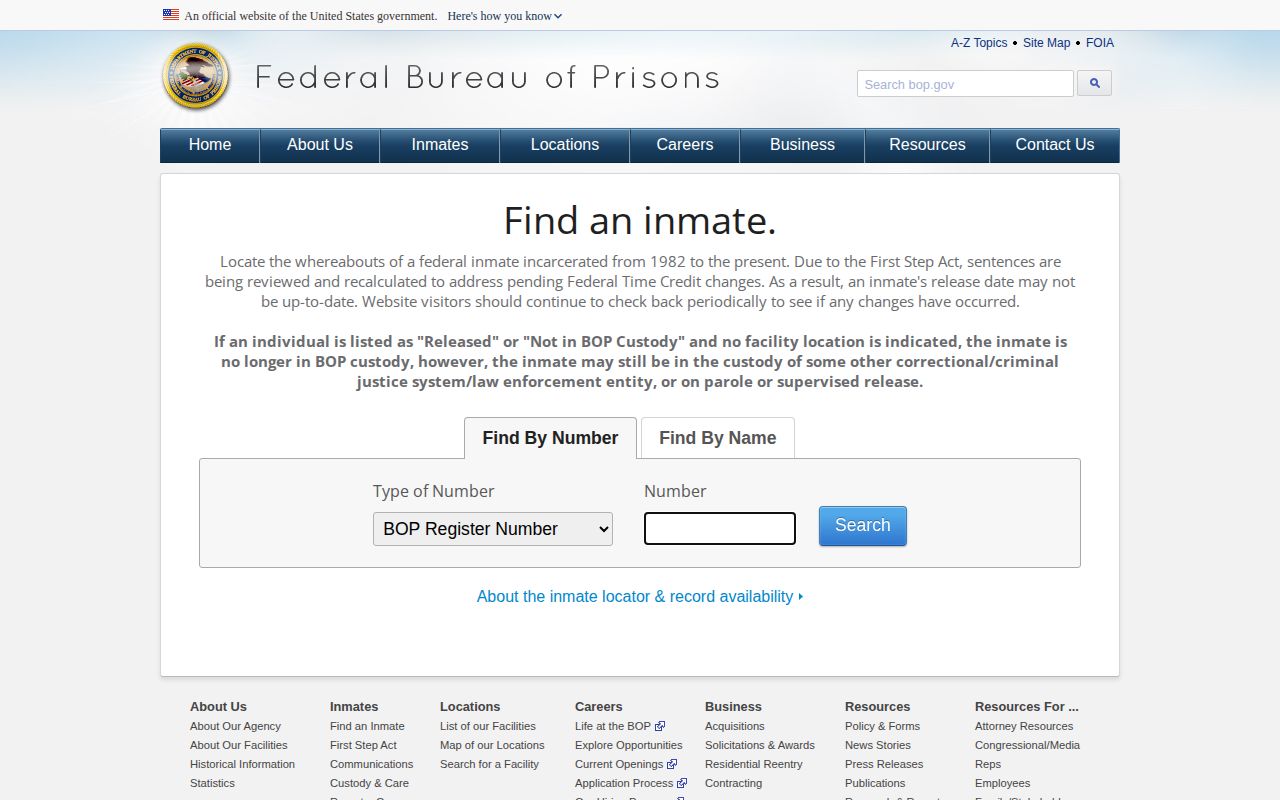
The captured interface shows why the register number, date, and location field should be recorded together rather than reducing the result to a yes-or-no release claim.
A screenshot is supporting evidence, not a certified record. Avoid capturing unrelated personal data. If the date or status changes, keep the access date and rely on the current agency display or responsive government record for the updated conclusion.
Clarke Federal Pretrial Release Records
The U.S. Marshals Service moves and holds federal pretrial detainees, often through contract facilities. USMS does not offer a general public historical release locator like BOP. That means a federal defendant may be absent from the BOP locator while still detained under federal authority. A host jail may provide physical-custody information, while the federal court supplies the controlling order.
Use PACER or the appropriate federal clerk for the docket, release order, detention order, bond conditions, and later modifications. Contact counsel when authorized. The USMS Prisoner Operations material explains its custody role, but it is not a name-search archive. Never equate an entered court order with completed physical release until conditions and other holds are resolved.
A sound pretrial timeline therefore has two parts: the court’s legal authorization and confirmation from the custodian that departure occurred. If the sources conflict, preserve both timestamps. The court is strongest on legal authority, and the host facility or responsible custodian is strongest on physical departure.
After a Clarke Federal Release
Federal supervised release is a court-ordered period after imprisonment. It is not BOP custody and should not be described as continued confinement. The federal judgment and probation record, within lawful access limits, address that obligation. A past BOP date can therefore coexist with active federal court supervision.
Another agency can also take custody at the end of the BOP term. A detainer is a request or legal basis that may produce transfer rather than community release. State charges, a local warrant, or immigration action may change the destination. Search the next named custodian instead of assuming the BOP endpoint is the end of the whole chain.
- Released
- No longer in BOP custody according to the displayed federal record.
- In transit
- Moving within federal custody or processing, not released.
- Projected date
- A future estimate that can change and does not prove departure.
- Supervised release
- Federal court supervision after imprisonment, distinct from BOP confinement.
- Detainer
- A hold or request that can lead to another custodian taking control.
Clarke Federal Custody Transitions
A federal search often begins because a person disappeared from a local source. If the person was last known at NRADC, ask whether the regional jail still displays current custody and whether a transfer destination can lawfully be confirmed. Then check BOP. A federal locator match can support a later federal commitment, while a no-result leaves open federal pretrial custody, another contract facility, or a delay before BOP designation.
The court case and custodian answer different questions. A judicial order can authorize detention or release and state conditions. The jail, USMS, or BOP record identifies the physical custody segment. A person can have a release order entered but remain held while conditions, transport, or another hold are resolved. Conversely, a person can leave one facility because federal authorities moved them without any release to the community.
Build the chronology one event at a time: last confirmed NRADC custody, any USMS movement, BOP designation, BOP release status, then any supervised release or new custodian. Include the source and search time beside each event. Do not fill an unknown interval by guessing where the person was held.
If the BOP record displays a past release date, compare that date with the federal docket before stating the legal result. If it shows “IN TRANSIT,” wait for a settled location or agency confirmation. If it shows no match, return to the federal court and USMS or host-facility route rather than converting absence into release.
Clarke County Federal Release Proof
For a completed-event conclusion, record the system, agency, exact wording, and search time. A BOP past release date is useful for the federal custody segment. A federal release order explains authority. Physical exit may still need confirmation through the responsible facility, and later custody needs confirmation from the next agency.
The BOP locator does not certify an NRADC release, a VADOC discharge, or an ICE release. Likewise, absence from BOP does not prove the person was never in federal pretrial custody. Keep each system within its actual coverage and use the federal register number or court case number when requesting clarification.
Federal Custody Routes
Designated or former federal inmate
BOP Inmate Locator, 1982 to present
Federal pretrial custody
Federal court, counsel, USMS, or the identified host facility
Release authority
The applicable federal court order
Note: The facility map lists a federal network because Clarke-connected people can enter it, not because a BOP prison is located in Clarke County.
Public Record Search
Sponsored Results